
Explore how AI is reshaping business—from markets, finance, and innovation to healthcare, work, and customer relationships. FIU Business research creates insights for business and society by examining where AI can create value, how people make decisions alongside AI, and what responsible adoption demands.

Research for an AI-enabled business world

MARKETS AND DATA
Can Market Data Tell a Tech Firm Where It Stands in the Cycle?Firms are investing record sums in AI and IT, yet the payoff arrives with long lags because complementary intangibles such as new processes and skills take years to build. Whether an investment pays off therefore depends on where the firm stands in the business cycle, but official recession dating covers only the whole economy and arrives months late. This study asks whether a single firm's phase (Expansion, Peak, Contraction, or Trough) can be detected from its own market data, and whether that phase matters for its performance.

FINANCE AND REAL ESTATE
Built to Predict: A Research Agenda for AI in Real Estate FinanceWhat if a lease's rent-reset clause could become an input to a smart contract, rather than a line someone must recheck? AI can extract rent resets and renewal provisions; validation and legal enforceability determine whether those terms can safely support automated execution. This connects AI and financial technology to the cash flows underlying property investment. Sixteen propositions connect AI capabilities to property prices, credit terms, liquidity, and investment. The economic framework asks how information extracted from contracts, images, and operating records changes the financial decisions made about a property.

HEALTH CARE
AI Medical Devices Carry 2.5 Times the Recall Risk of Non-AI DevicesFDA data on 26,535 devices cleared from 2004–2024 show AI-enabled devices have about 2.5 times the hazard of a first recall, driven by design and software failures. The researchers translate these findings into a decision-support model for allocating validation resources.

ENVIRONMENT AND FINANCE
Impact of Artificial Intelligence on ESG IssuesNearly 100 GW of new data-center capacity is expected between 2026 and 2030, doubling global capacity to meet AI demand. With an expected 14% annual growth rate, the project examines data-center revenue and environmental economics, including the need to ease grid and water constraints.

HEALTH CARE AND ORGANIZATIONS
From Ambiguity to Action: How Healthcare Organizations Engage in Disruptive Sensemaking to Implement Generative AI StrategiesAn interpretive case study at a large Florida health system finds that successful generative-AI adoption depends on six interconnected practices: challenging assumptions, building governance, setting evaluation measures, adapting through feedback, managing risks, and aligning AI with long-term strategy.

RESPONSIBLE AI AND INFORMATION QUALITY
AI-Generated Search Summary Warning Messages Increase Verification BehaviorWhen individuals search online through search engine platforms such as Google, Yahoo, and DuckDuckGo, they increasingly see an AI-generated summary at the top of the results page before they see website links. These summaries save time by pulling information from multiple sources into one concise answer. Yet generative AI can make mistakes or present uncertain claims with unwarranted confidence. Because the summary appears authoritative and is immediately available, users may accept it at face value rather than checking the underlying sources. This research asks the question: can warning messages prompt users to verify the information in AI-generated search summaries?

WORK AND CULTURE
Cultural Work Ethics and AI Adoption: How AI Use Shapes Performance Evaluations Through Effort and Competence Perceptions Across Four CountriesAcross two experiments with 1,000 working adults in the U.S., India, and South Korea, we test how disclosing generative AI use shapes performance evaluations. Disclosure lowers perceived effort in every country, but whether that translates into lower ratings, bonuses, and future assignments depends on national context and evaluators’ work ethic.
BANKING AND CUSTOMER EXPERIENCE
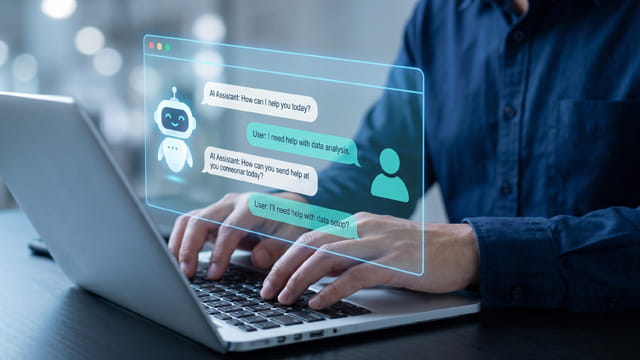
Can AI Chatbots Replace Human Customer Service in Banking?This study evaluates AI-powered chatbots used by leading U.S. banks through standardized tasks across ten categories. We compare online-only banks with traditional banks operating physical branches and assess accuracy, precision, and failure rates. Results reveal significant performance variation and suggest that banking chatbots primarily complement, rather than replace, human customer service.

ACCOUNTING AND REPORTING
A Review of Artificial Intelligence (AI) in Financial Accounting & Reporting ResearchThis review maps research on artificial intelligence in financial accounting and reporting, summarizing what is known about AI’s effects on auditing, disclosure, and financial-statement quality.

MARKETING AND CONSUMER BAHAVIOR
AI as a Relational SignalThis research introduces perceived brand social capital: consumers' perceptions of how strongly a brand is tied to their local community. Across seven studies (three pre-registered and four supplemental), a brand's AI use lowered perceived social capital and, in turn, loyalty, especially for small brands. Visible community involvement buffered this effect.

HUMAN-AI COLLABORATION
Unpacking the Dynamics of Bias, Decision Revision, and Performance in Human-AI CollaborationUsing repeated-measures data from two online experiments on AI-assisted phishing detection, this study examines how cognitive and motivational biases shape decisions across stages of human–AI collaboration. Cognitive biases can undermine performance, particularly when people revise decisions with AI support, while a stronger sense of control is linked to beneficial revisions and improved performance. Concrete explanations are associated with fewer, more accurate revisions, though not higher overall performance.
View Insights
HEALTHCARE AND ETHICS
Can LLMs Make Ethical Recommendations in Healthcare?Context matters: uncertainty and moral intensity demand human judgment. Guided by Hosmer’s Ethical Decision-Making model, this study introduces an EDM Matrix that classifies ethical situations by moral awareness and outcome uncertainty. Evaluations of ChatGPT, with selected comparisons to Gemini and Grok, found the most consistent recommendations when awareness and uncertainty were low; responses became more conditional as both increased. The framework helps healthcare administration students examine AI assumptions and reinforces critical evaluation, human oversight, and accountability in complex decisions.
View Insights
MENTAL HEALTH AND AI
Teaching AI to Hear a Quiet Cry for HelpSuicide is the second leading cause of death among Americans aged 10 to 34, yet the instruments used to identify risk are episodic while risk itself fluctuates between clinical encounters. Conversational AI could help close this gap, but general-purpose chatbots have responded inconsistently to suicide-related disclosures and now face regulatory scrutiny. Following design science research methodology, this study designs, builds, and formatively evaluates BesideU, a mobile AI companion that estimates youth suicide risk from five signal families (linguistic, behavioral, emotional, digital engagement, and social connection) observed over time, and routes users to proportionate human support. The system reached 91% accuracy. In a non-clinical pilot with 47 FIU students and staff, participants rated satisfaction an average of 4.2/5. Its goal is to let AI notice while people decide.
Contact Us
AI360 is dedicated to fostering an environment where AI innovation thrives, preparing our community to lead in a technology-driven world.
Email: ai360@fiu.edu