
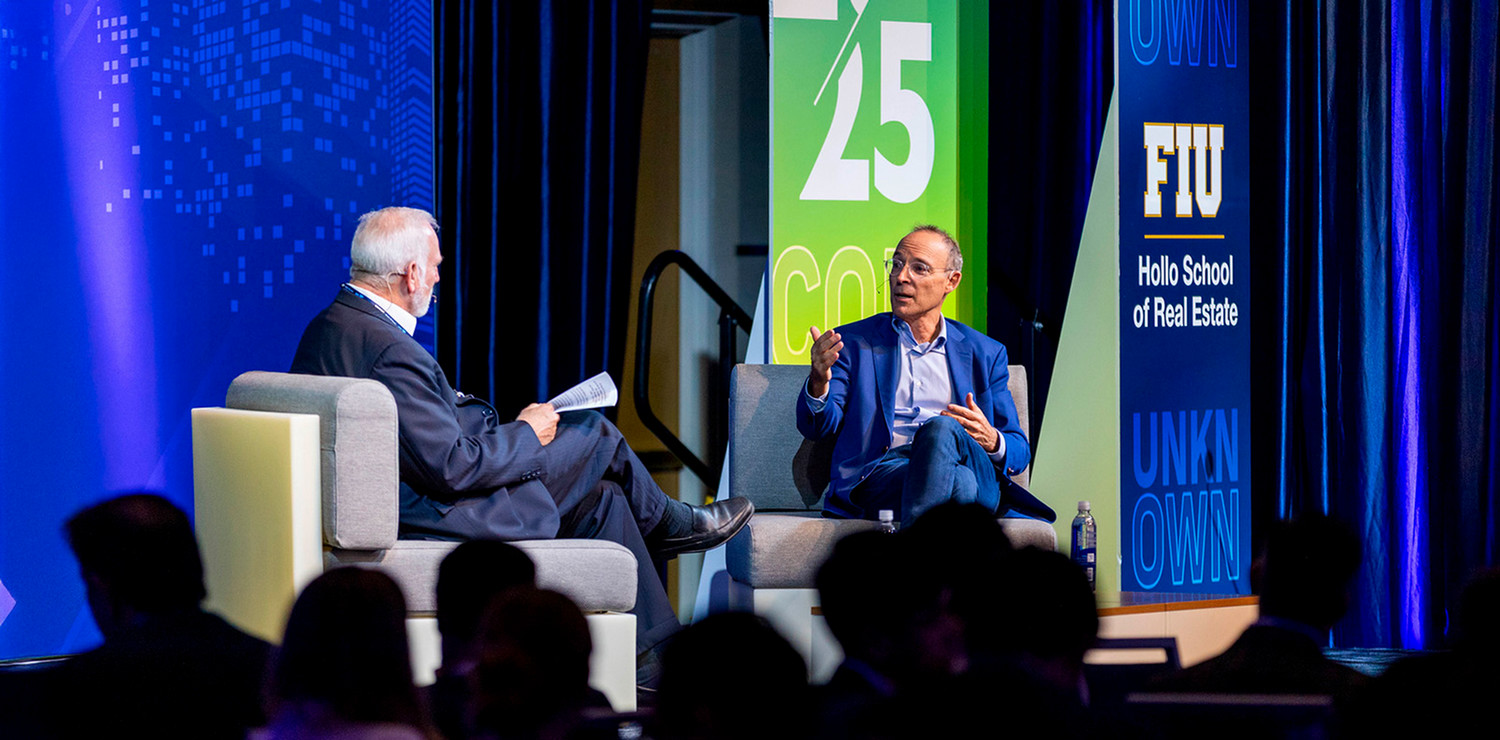
Uncertainty isn’t a warning, but an opportunity. That message defined the sold-out REact 2025 Real Estate Conference hosted by FIU Business on November 14. The event brought together more than 300 real estate executives, investors, lenders and students to analyze the forces reshaping property markets in South Florida and beyond.
The theme, “Navigating the Unknown,” captured a sentiment felt across the industry: a strong, resilient market entering uncharted territory as Miami continues its transformation into a global city.
Miki Naftali, chairman and CEO of the Naftali Group and a developer with decades of experience across major U.S. and international markets, sat down with Clay Dickinson, FIU Business teaching professor of real estate, to discuss Miami’s development landscape. Naftali emphasized that successful projects start with rigorous research and a clear, unfiltered understanding of what buyers truly want.
“You need to know there is demand,” he said, explaining that thoughtful planning, market analysis and customer insight shape the most successful projects. He highlighted Miami’s growing reputation as an international lifestyle hub where buyers are discerning, and expectations are high.
Craig Robins, CEO and president of Dacra, which transformed the Miami Design District into a global hub for fashion, art and culture, shared his vision a thriving market defined by rapid change.
Rather than focusing on spreadsheets or short-term predictability, Robins explained that successful placemaking requires patience, imagination and an understanding that value is created over decades. “I want each piece of land in our neighborhood… to make the whole neighborhood worth more,” he said, describing a strategy that turns uncertainty into long-term opportunity.
While Miami attracts unprecedented interest from luxury and international buyers, a conference panel on capital markets explored the complexities underlying the state’s rapid rise.
Panelist Justin Harp, managing director at FHN Financial, noted that worker housing across Florida is “becoming harder to deliver,” as construction costs, wages and inflation reshape project feasibility. Markets like Naples and Jacksonville are seeing workers commuting more than an hour each way — a sign of pressure that could intensify without strategic investment.
Despite these strains, panelists agreed Florida remains one of the strongest U.S. real estate markets. Michael DiCosimo, senior director of capital markets at commercial real estate and investment management company JLL, pointed to the state’s No. 2 national ranking in population growth and South Florida’s No. 4 ranking among metro areas in 2024. He noted that Miami’s economic base continues to diversify, with technology, life sciences and corporate expansions adding new layers to the region’s workforce.
Industry veteran Stephen Bittel, founder and chairman of Terra Nova, offered a candid perspective on entrepreneurship during his fireside chat with moderator Jamie Levenshon, senior vice president of commercial real estate at Insurance Office of America and a member of the FIU Hollo School of Real estate advisory board.
“We all learn more from the losses about what not to do,” Bittel said, adding that success depends on preparation, curiosity and relentless effort. “I was sure I was never going to be outworked.”
His reflections echoed the conference theme: thriving in real estate requires both knowledge and the grit to move confidently through uncertainty.
Eli Beracha, director of the Hollo School, tied the day’s conversations together with a data-driven market update. Interest rates have eased from their highs, spreads continue to normalize and Miami’s long-term fundamentals remain strong, he said.
Beracha also noted FIU’s position as a national leader in real estate education — ranked No. 1 globally for real estate research and graduating more master’s students in the field than any U.S. university — as he announced that REact had reached a record 350 registrants.
If the event underscored anything, it was that Miami’s next chapter will require adaptability. The region is booming, but challenges like affordability, infrastructure and shifting demographics demand thoughtful responses.
The next REact conference is slated for November 2026.
View images from REact 2025 at this link.