

Artificial intelligence is no longer a technology leaders can afford to merely observe from the sidelines. For many organizations, it is already shaping how work gets done, how customers are served and how risk is managed. That reality was the driving theme of AI 305, a sold-out conference hosted by FIU Business on September 18, 2025. It brought together executives, technologists, policymakers and entrepreneurs to examine how AI is actively transforming South Florida’s economy.
Across every panel, one message was consistent: the companies gaining the most value from AI are not necessarily the most technical – they are the most intentional. For business leaders, the conversations offered clear signals on where AI is delivering immediate returns and how to deploy it without losing trust, culture or control.
Smarter Care, Smarter Business
If any industry understands complexity, regulation and risk, it is healthcare. That is why one of the most instructive conversations at AI 305 came from leaders working at the center of patient care – where the margin for error is thin and trust is everything.
In the panel Smarter Care: How AI Is Transforming the Patient Journey, moderated by Attila Hertelendy, assistant professor of information systems and business analytics at FIU Business, speakers made clear that artificial intelligence is already reshaping healthcare. The real transformation, they said, is happening quietly, behind the scenes, in workflows, data integration and decision support.
Jorge Camilo Mora, associate dean at the FIU Herbert Wertheim College of Medicine, described how clinicians spend increasing amounts of time navigating electronic systems and administrative requirements, often at the expense of patient interaction. He said, AI can help return time and attention to the human side of care when implemented thoughtfully.
Oscar Perez, chief application and innovation officer at Health Choice Network, pointed to fragmented systems as a persistent obstacle. In healthcare, patient data often lives across disconnected platforms. In business, the same challenge appears as siloed customer data and duplicated processes. AI, Perez argued, becomes powerful when it connects those silos into a coherent picture that supports better decisions.
Securing the Digital Frontier
While AI is powering innovation, it’s also arming cybercriminals. In the panel Securing the Digital Frontier, experts from cybersecurity firm Darktrace and FIU sounded alarms about the dual-use nature of the technology. “The attacks are coming faster,” said Helvetiella Longoria, FIU’s chief information security officer, noting that phishing scams are now nearly indistinguishable from legitimate emails thanks to generative models that eliminate telltale errors.
Lawrence Embil (BBA ’95), security manager for Miami-Dade County, described using AI to triage more than 3 billion monthly cybersecurity events: “Without machine learning, we’d be chasing noise all day,” he said. Yet, despite its power, panelists stressed the need for human oversight of AI. “AI can block malicious IPs in seconds,” Embil noted, “but you still need a human in the loop. You can’t abdicate responsibility to the machine.”
The takeaway for leaders is not fear, but urgency. Organizations that delay upgrading their security posture risk falling behind adversaries who are already using AI to move faster than humans can respond.
“Without machine learning, we’d be chasing noise all day.”
— Lawrence Embil
The Titans of Tech
In the Tech Titans session, representatives from Meta, Amazon Web Services and Google pulled back the curtain on how Big Tech is enabling transformation for businesses. Google executive Andy Luc (MIS ’08), global head of core infrastructure and reporting, trust and safety, shared the company’s approach to setting and enforcing standards for its products, including the use of generative AI, automation and machine learning to prevent policy violations like using Google products to mine for cryptocurrency.
“Traditional machine learning algorithms identify policy violating activity, and then we also have human experts,” said Luc. “Now with Gen AI, we see that the bad actors are now doing things at scale, so we have to meet them where they are.”
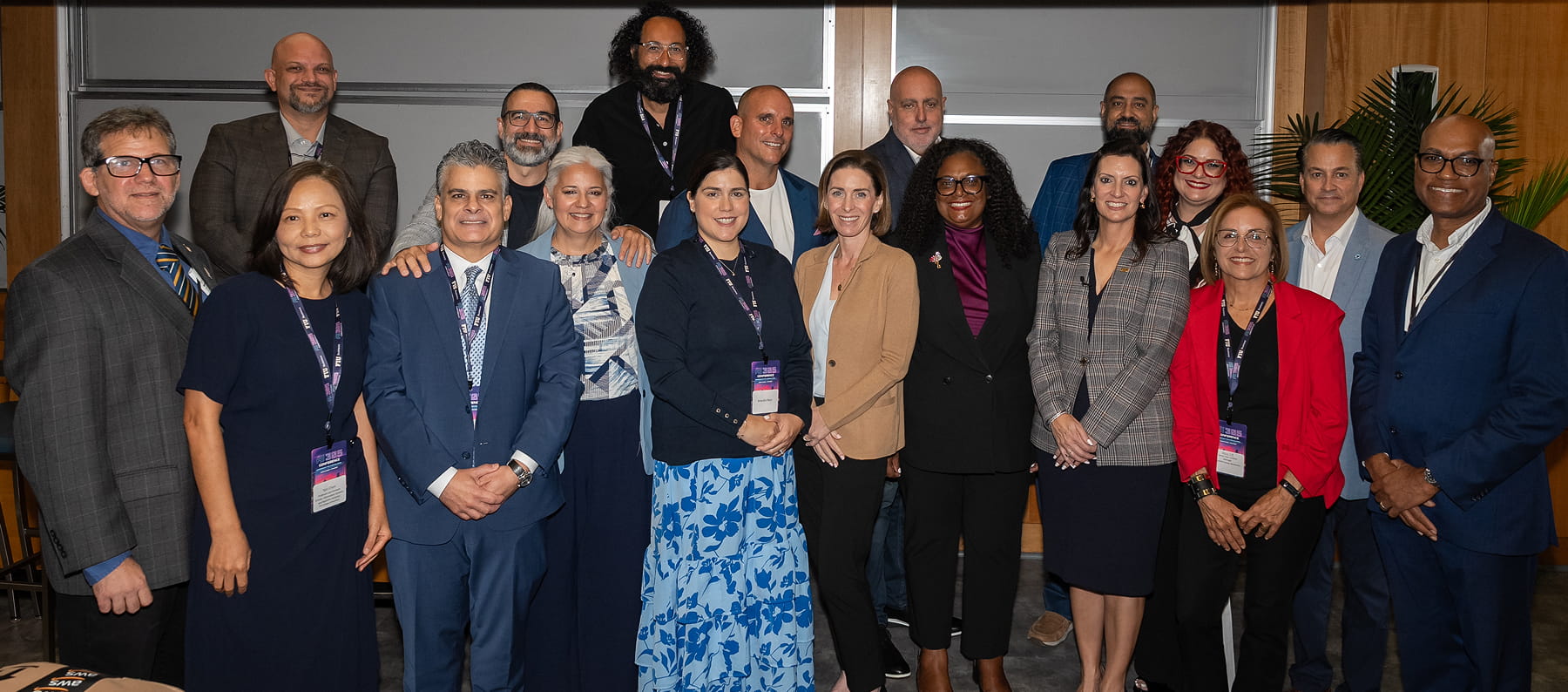
The panelists made clear that AI adoption is no longer limited by ideas – it is limited by infrastructure and skills.
Amazon’s team underscored how cloud computing has become the foundation for AI adoption. “Infrastructure is the next big challenge,” said Charly Maltagliatti, client partner for Meta. “AI is powerful, but it’s expensive. The real opportunity is building the systems – and the talent – to sustain it.”
“AI is powerful, but it’s expensive. The real opportunity is building the systems – and the talent – to sustain it.”
— Charly Maltagliatti
Reinventing Customer Experience

In hospitality and entertainment – two cornerstones of Miami’s economy – AI is redefining how companies connect with customers. Third-generation restaurateur Carlos Gazitua of Sergio’s Restaurants recalled introducing robots during the pandemic. “People said I was taking jobs away,” he said, “but the robots helped servers serve more tables and make more money. The goal wasn’t to replace people–it was to make them better at what they do.”
Others echoed that sentiment. Christina Abra from the historic bakery Abuela’s Sweets experimented with a bilingual service robot named “Cecilia AI,” first developed at FIU’s Chaplin School of Hospitality. After mixed reactions from older customers, she redeployed the technology to the kitchen, using it to optimize recipes and reduce waste. “Our clients come for nostalgia,” she said, “so we kept the tradition front of house and put AI behind the scenes.” Maria Rodriguez, former president of Latin America for Subway, may have summarized it best: “The hospitality business will always be about people. AI just helps us deliver that connection more efficiently.”
“The hospitality business will always be about people. AI just helps us deliver that connection more efficiently.”
— Maria Rodriguez
The Future of Work Arrives Early
A final panel titled Reimagining the Future of Work asked a fundamental question: what does AI mean for people? Jeiner Morales of BankUnited called AI “a blank canvas” that allows employees to innovate faster than ever. Dora Cortinas, adjunct professor of information systems and business analytics at FIU Business and vice president of data and analytics at Keurig Dr Pepper, added that “companies must plan for the pace of change itself – it’s faster than anything we’ve ever seen.”
“Companies must plan for the pace of change itself – it’s faster than anything we’ve ever seen.”
— Dora Cortinas
A Miami Moment for AI
From academia to enterprise, the consensus at FIU’s AI 305 was clear: South Florida is no longer just a hub for tourism and trade – it’s becoming a living laboratory for applied artificial intelligence.