

In the 1980s, when Gabriel Rodriguez’s father brought the first computer into the family’s customs brokerage business, it didn’t feel like the future so much as a fire hazard.
“He’d freak out every day that somebody would leave it on and not turn it off,” Rodriguez said. “He’d walk over and unplug it to make sure the building wouldn’t burn down.”
Today, Rodriguez (BS ’96) is president of the family business, A Customs Brokerage, and he’s the one pushing technology. In a highly regulated corner of global trade, where paperwork is relentless and processes can lag behind other industries, Rodriguez believes automation and AI have become a great equalizer, helping small and mid-sized companies move faster, serve clients better and win business that once belonged to much larger players.
“We are light-years ahead of what the competitors are doing,” Rodriguez said. “It’s a very manual, very regulatory government-oversight industry. We’ve pushed that envelope.”
Today's Advantage: Speed, Not Size
For decades, small businesses competed on relationships while larger companies dominated on resources like consultants and specialized software. AI and automation are changing that equation.
“This is the most democratizing aspect of AI,” said Pouyan Esmaeil Zadeh, associate professor of information systems and business analytics at FIU Business. “The playing field is inverted in favor of speed and responsiveness, which is where small businesses win. Large companies have legacy systems and layers of approval. Small businesses have agility. The large company is still debating; the small business is shipping.”
Esmaeil Zadeh argues that the current moment is a window. AI is powerful but its adoption isn’t yet universal. Entrepreneurs who learn it now can build an edge over competitors who wait. But he cautions against the idea that AI replaces everything. If execution becomes cheaper, judgement becomes more powerful. “It’s not AI versus people,” he said. “It’s AIamplified people versus people still working alone.”
“The playing field is inverted in favor of speed and responsiveness, which is where small businesses win.”
— Pouyan Esmaeil Zadeh
Competing for Clients No Longer Out of Reach
There was a time when Rodriguez assumed his firm of about 50 employees couldn’t service certain accounts. “Over the last few years, we can compete at a larger level because of increased efficiencies,” he said.
Now the company has landed larger Fortune 500 and international businesses that were previously out of reach. Some customers, he added, would rather work with a smaller partner that’s efficient and responsive than with a larger one where they feel like “just a number.”
How to Think About AI
The most useful way to view AI, Esmaeil Zadeh said, is not as futuristic magic but as practical leverage. “AI and automation are tools that let small business owners rent a team by the hour, often for the cost of a few subscriptions.”
Used well, AI can handle repetitive work (emails, scheduling, data entry), accelerate research and analysis, and remove friction between planning and execution. Automation makes the gains scalable by routing information and triggering followups without constant human intervention.
That “tool, not replacement” mindset also shows up in how finance teams are adopting AI. At IntellectAbility, a company that designs instructional curriculum housed in a learning management system for people with intellectual and developmental disabilities, CFO Viet Vo (MBA ’25) said AI is less about replacing staff and more about removing tedious steps, especially in analytics and back-office workflows.
For example, instead of relying on four to five people to combine databases and build pivot tables in Excel, automated workflows consolidate information and deliver revenue analysis, cost analysis and year-over-year reporting more quickly, improving accuracy and giving leadership better inputs for decisions.
Invoicing is another example. The CFO - Vo - utilizes AI to take an invoice, capture the information, and place it into correct accounting categories, then label it and make sure it is paid on time. These steps take less than a minute now, freeing up bandwidth for higher-level analysis.
Vo cautioned business owners not to treat AI like another employee. “Don’t use it to replace an employee,” he said. “Use it as a tool to improve the job you already know how to do.” AI works best, he added, when you already understand the underlying task well enough to verify whether the result is correct. Otherwise, you might not know if the output is accurate.
He also warned that not every tool is worth adopting. “Not all AI is created equal,” he said. “Don’t assume the first solution you see will be beneficial. The humanistic factor is what helps us be better at what we do. Without it, it’s just another tool.”
The biggest obstacle isn’t technical, Esmaeil Zadeh noted. It’s psychological. “Entrepreneurs need to get past the idea that ‘real work’ means sitting at a computer for eight hours. If a small business owner can navigate Netflix to find a show, they can navigate most AI tools.”
Built to Suit
That ease of access, however, doesn’t mean AI can be used carelessly. Hemang Subramanian, associate professor of information systems and business analytics at FIU Business, describes AI as a productivity multiplier that only delivers results when business leaders learn how to use it correctly.
“AI can dramatically increase productivity, but success depends on understanding its limitations,” Subramanian said. Identifying hallucinations, applying guardrails and verifying outputs are essential, particularly as businesses move from experimenting with large language models to deploying smaller, more targeted systems designed for automation.
While most of the AI hype has focused around large language models, Subramanian points to the growing importance of medium- and small-parameter models that can be customized for specific business needs. These models, he said, often sit at the heart of automation efforts, where reliability and precision matter more than scale.
AI falls into three buckets, Esmaeil Zadeh explained. First, ask a question and get an answer. Think ChatGPT, Claude and Perplexity. Second, push a button and get a result. Think Invideo AI for video creation, Midjourney for image generation, Canva for graphic design. Finally, connect the tools together. Think automation platforms like Zapier. “Even this is becoming ‘no code,’ where you click ‘when this happens, do that,’ and you’ve built a workflow,” he said.
The Talent Layer
Essential engineers, developers,
and business leaders working
across every level of the stack.
The Application Layer
Tools for image generation,
design, analytics and social
media management.
The Model Layer
Large models like GPT and
Claude, alongside millions
of open-source models such
as Hugging Face.
The Infrastructure Layer
Specialized hardware, data
centers and power systems
that enable AI processing.
The Semiconductors Layer
Advanced semiconductor
chips and processors.
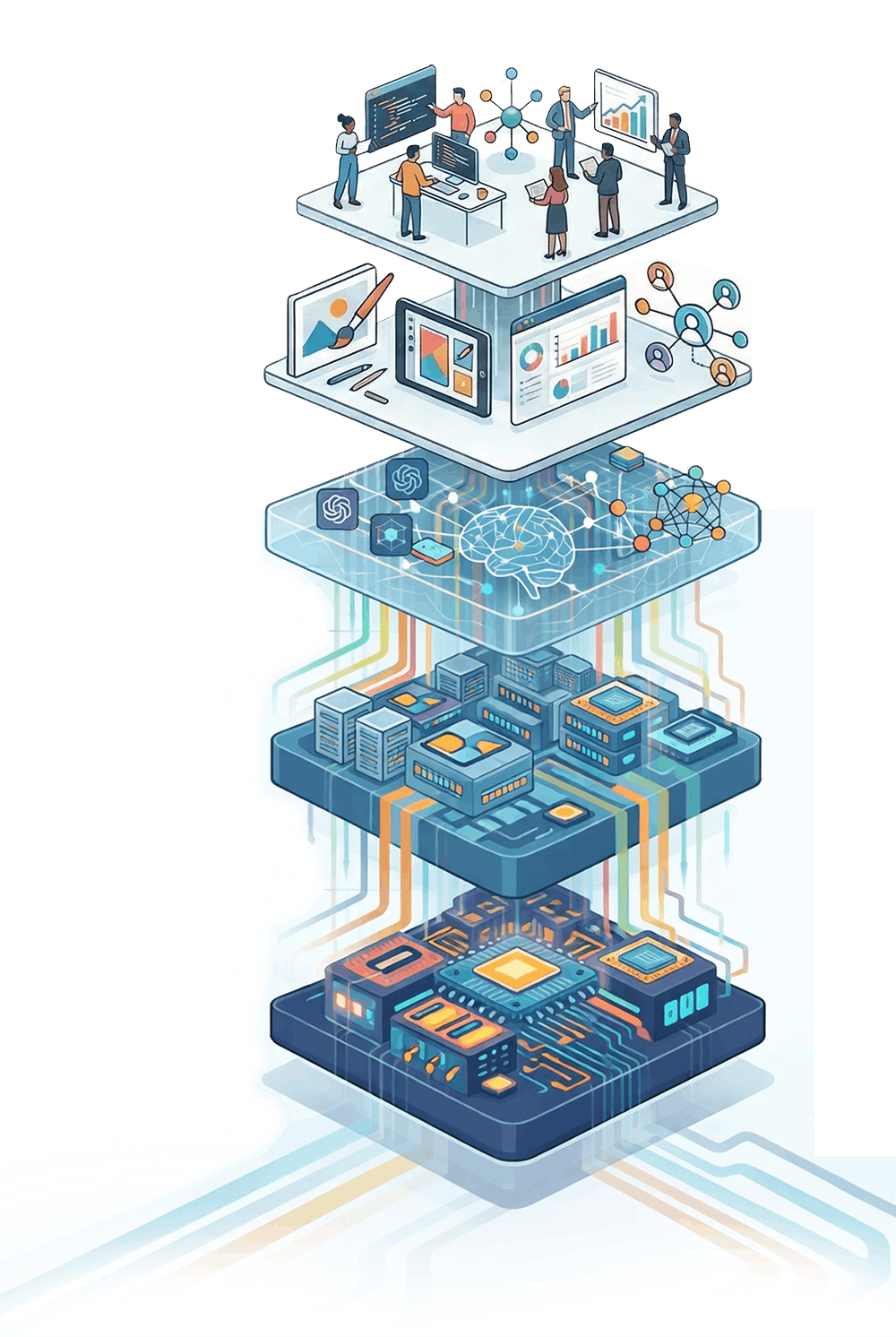
Illustration generated with AI
Subramanian frames these tools within a broader five-layer AI stack that helps business owners understand where and how they can participate. The application layer includes tools for image generation, design, analytics and social media. Beneath that sits the model layer, which includes large models such as GPT and Claude, alongside millions of open-source models available through platforms like Hugging Face. Supporting those models is the infrastructure layer, made up of specialized hardware, data centers and power systems, followed by the semiconductor layer that continues to advance rapidly. The final layer is talent, spanning engineers, developers and business leaders working across the stack.
Small and mid-sized businesses, Subramanian said, don’t need to own every layer to benefit. They can build applications, customize models or simply apply AI-enabled tools in ways that align with their size and strategy.
Where do Small Businesses Begin?
Email is a practical place to begin. “Every business uses email,” Rodriguez said. “It is definitely something you want to get ahead of.”
Esmaeil Zadeh recommends starting small: identify one bottleneck, run a one-week experiment and build a simple toolbox of a few solutions for the problem you choose. A strong candidate for automation is a task that takes more than three hours a week, follows a repeatable pattern and doesn’t require deep judgement.
The common mistake is “Tool FOMO,” or buying too many subscriptions and ending up with a confusing workflow. Cost doesn’t have to be a barrier. Start with free tiers, then upgrade after you prove return on investment. “The expensive part isn’t the tools, it’s the opportunity cost of not using them,” Esmaeil Zadeh said.
Small and mid-sized business owners assume AI is too expensive or complex. Esmaeil Zadeh points to popular tools that cost roughly $10 to $50 a month and argues most are within reach. Others fear losing control of brand voice. He says founders still set strategy and tone while AI helps draft and iterate. “Think of it like spellcheck or a calculator,” he said. “It doesn’t make decisions. It accelerates your thinking.”
Remember that AI amplifies your systems. If your systems are messy – for example, if data gets corrupted or workflows change – AI will make them messier, faster, he noted.
Agentic AI, Manufacturing and What's Next
Subramanian also points to the rise of agentic AI, where systems don’t just generate recommendations but take action, as a turning point for the software industry. In software engineering, AI has already enabled teams to multiply their output, reducing development timelines and lowering the cost of experimentation.
For business leaders, he said, autonomous coding has removed a longstanding bottleneck: the expense and delay of building and testing new software ideas. This shift has made it easier to pilot new products, processes and workflows before committing significant resources.
Manufacturing is undergoing a similar transformation. The growth of robotics, collaborative robots and robotic process automation has accelerated the emergence of so-called dark factories – facilities that operate around the clock with minimal human presence on the floor. For manufacturers, the result is greater efficiency, consistency and scalability.